Friday, 18 March 2016

a few last kastoms

My brother returned from Australia where he spent the last 6 months picking oranges with other Ni-Vanuatu. We had a small kastom ceremony for him at the school to welcome him back. This consists of speeches, gifts of mats, kava, and laplap (the big 3!) and being covered in baby powder and calico. The main part of the welcome back ceremony is the presenter handing them a green coconut and them finishing it in one gulp.
that baby powder glow


smiles!

first born and papa
 Last October my papa had the chance to go to China for a Pacific island economy workshop for three weeks. The whole shebang was eerily paid by the Chinese government. Still not sure what that’s all about but! He was chosen to go and see a different country and meet people from all over. It was a great trip, and I guess our community hadn’t properly welcomed him back. So on a Saturday 4 months later, it happened. The whole day was spent preparing for the welcome back kastom ceremony! I’ve talked in astonishment before about how impressive it is to watch the machine of women making laplap in operation. Sometimes men and kids help, too, but it’s primarily female domination when it comes to laplap.

Here’s what that looks like:

• Building the fire to heat the stone to make the earth oven
• Grading the taro, manioc, green banana, yam, and/or kumala
• Collecting the “laplap leaves” and wrapping the mush for baking
• Removing the hot hot stones, placing the bundle in the pit, and covering it back up with the stones again. You use a big branch that’s split ¾ of the way down as bigfala tongs.
• Meanwhile, dehusking, cracking open, and grading the coconuts
• Milking the shredded meat and boiling it into cream.
• Once the laplap  is finished cooking (I think a sixth sense notifies everyone here that it’s ready) you remove the stones and the laplap bundle, open her up, and dribble coconut cream all over it
• A note on this! I’ve never seen anyone pour the cream on the laplap and smear it around. This would be much more efficient. Instead they take a spoon and drizzle it on randomly until it covers the whole thing. I’ve asked a few women why the do this and they looked at me like I was crazy. It’s just what they do!

I sat down with my bumbu Joyce and cousin Kendra and helped with the coconut grading. Other than the 3 laplaps being made on the school grounds, many more were in the works in individual kitchens around the community. My papa and uncle went and killed one of my brother’s mama pigs because she’s got a terrible habit of eating baby chicks. I learned that this Wala (all of the pigs are named Wala) is the mama of so many other Walas I know. Strike three, Wala, sorry. They shot her in the bush and then two men carried her down on a bamboo pole. They butchered the pig and put it (her?) in an earth oven to bake. I didn’t grow up eating pig, so I never had a taste for it before here. But let me tell ya, fresh, well-fed, baked or roasted pig is a delicious treat.

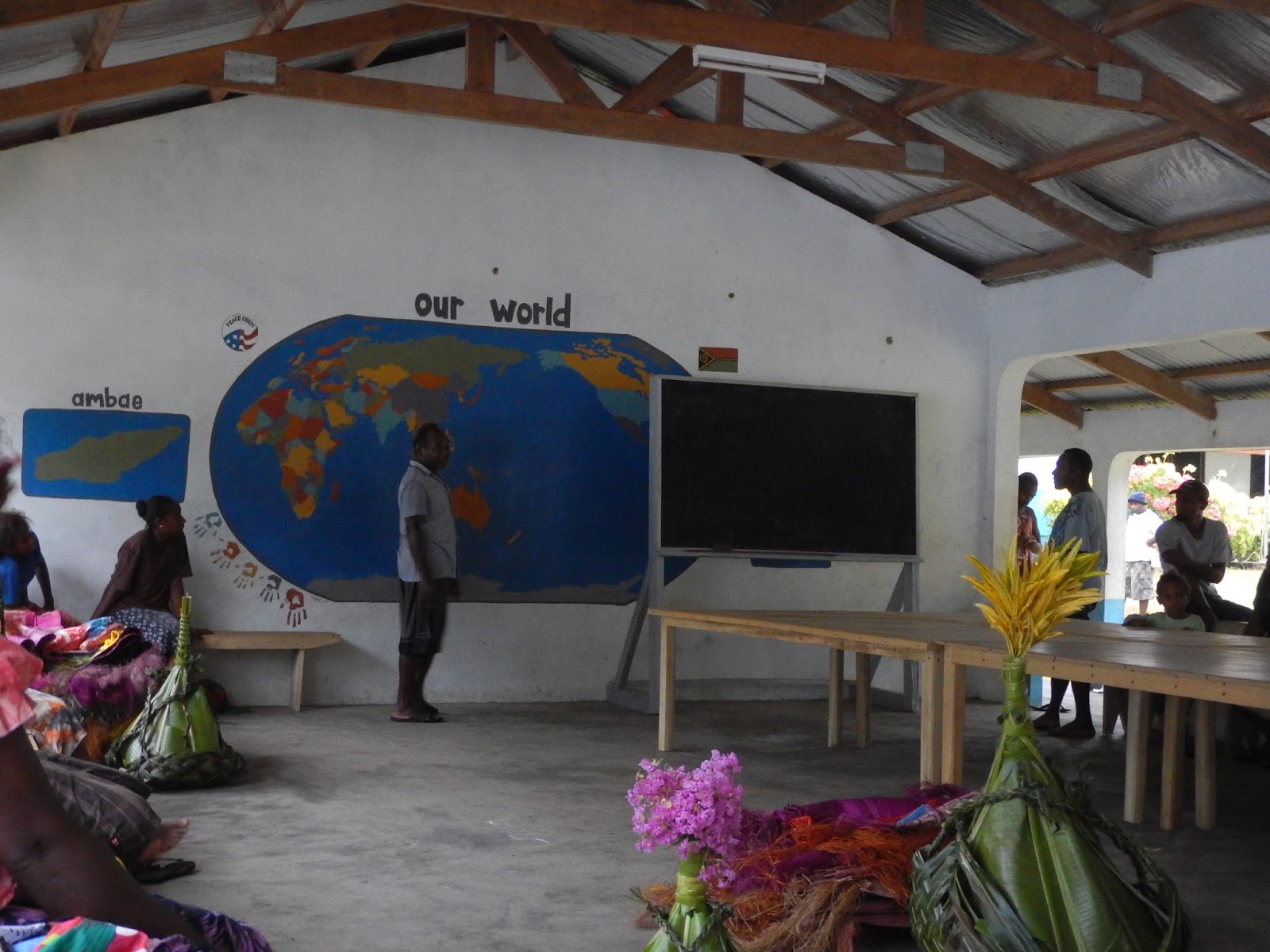
After lunch time our laplap was ready. Almost like clockwork, a slew of women with laplaps and mats balanced on their heads enter the school. The ceremony began mid-afternoon. Because it was a rainy Saturday, we were inside the assembly hall. My papa used the world map to explain his China travels and everyone ooo’d and ahhh’d thinking about the foreign land.  Mats were given to my papa and then he gave some to the auntie that presented him. Lots of mat exchange in these parts! My uncle John Richard got back from Australia recently, too, where he manages Ni-Vanuatu groups of fruit pickers. His brother died from a heart attack while doing the same this in New Zealand, so my uncle came back to grieve with his family. They presented him with mats, too. We all drank kava and feasted on the good food in front of us. Welcome back Papa!

kendra and bubu joyce on laplap duty

backyard kava pulls


explaining his china adventure


There are many traditional ways to prepare kava and these vary from island to island. Preparing kava just refers to the process of transforming it from intact root crop into mush so it can be sieved with water for drinking. For example, on Tanna and Aneityum, they chew the kava. In some areas of Tanna this is done my virgin boys only! On some islands they ram it into a stone and on Ambae they grind it into a long wooden bowl with a wooden pestle. It’s called qasis (pronounced kwa-sees) and only a few men still have the tools needed to make it this way. Nowadays everyone primarily uses mincers to mushify their kava. These hand grinders are all over the place on every island! One time I made the mistake of asking if I could use one to make peanut butter. It was a definite no.

The traditional preparation methods result in a much more potent shell of kava. On Chief’s Day, my cousin Hickman brought down a stumpa of kava from his garden and Uncle John Richard agreed to grind it for me. I drank two shells with my brother and mama, and the rest was brought over to the mincer for easy prep. I had a few more shells of that and slept soundly in my kava-induced slumber.

qasis!


sweet nectarine


one last shabang

At the end of service, the Peace Corps treats you to a few days in bungalows with your cohort before everyone splits. Really, its purpose is to remind us what resumes are, make sure we don’t have tuberculosis, and forewarn us of the realities of reverse culture shock and what a rapid increase in dairy consumption may do to our bels. Our COS (close of service) conference was held in January on the east coast of Efate at a charming place called Crystal Blue. Cyclone Pam really did a number on Crystal Blue, wiping out all of the guesthouses and many of the staff homes. However, the owner spent the last year or so repairing, and we had the pleasure of being some of their first guests after the storm. They did a great job rebuilding – the place is gorgeous! And our bungalows sat right on the water.
snorkel city
kate and bryan

The Peace Corps sessions were generally helpful, if not amusing, and it was a wonderful few days of hanging out with really great people. And the food! Wow! We were certainly well-fed with the best food I’ve tasted in Vanuatu. The chef is from the northern Banks islands, only schooled until 3rd grade, and never received any formal teaching on how to cook his delicious meals. I know all of this because I went to the back to ask for his recipes and this led to a never ending flow of life stories, which is the usual program here in Vanuatu, so I knew what I was getting into. Breakfast, lunch, dinner, and even wasemaot (wash ‘em out, the food you eat while drinking kava) were all incredible. Our last night there we had a big feast and I think everything on the menu was meat – pig, beef, chicken, fish, prawns.
conference room

lovers

The days of COS were spent in sessions, swimming, stuffing our faces, and storying. The evenings were filled with kava, wine, and chatter. A few times I would just look around and observe this group of friends knee deep in conversations about what’s next and where to now. There was even a pretty impressive dance party! It was such a treat to see everyone. During our in-service training back in June 2014, Jen took video interviews of each of us, asking what we’d tell ourselves in two years. Well, two years later at COS conference, we watched the video she compiled! It was fun seeing our past selves, a little chubbier and still wide-eyed from all the strange novelties of service. Recently Jen asked us to all submit a quote to summarize our service that she added to the video. Now I, lover of quotes, had a difficult time choosing, but I landed on this one because it resonates with me:

“Who could be so lucky? Who comes to the lake for water and sees the reflection of moon.” –Rumi

I came to the Vanuatu eager for two great years where I’d help a community, engage in some cultural exchange, and make lasting friendships. I had practical expectations of service, skill share, and exotic food. What I got out of it was immeasurably more profound and far beyond anything I could have ever expected. Who could be so lucky?

At the end of the 3 day dance, the whole staff came and we presented them with thank you gifts. Everyone boo-hoo’d in complete gratitude for the experience we’ve created and endured for two years – all pretty impossible without the kickass and ever-kind Peace Corps Vanuatu staff.

We headed back to town for our sunset booze cruise around Port Vila harbor. They let us know beforehand that it was, in fact, not a booze cruise, and that alcohol was “strictly prohibited.” Being the resourceful volunteers we have grown to become, everyone filled their nalgenes and baskets with the proper tools for a tipsy sunset. When we got on the boat, we were pleasantly surprised to find out that “strictly prohibited” actually meant that they gave us 3 free drinks! At least that’s what the captain decided, and you can’t really argue with a captain on board ship. So we drank champagne and strolled around the harbor while the sky morphed into one of the nicest sunsets I’ve seen, made even more magical because I was surrounded by some of my favorite company.


solo our training manager and his bottle of kava


That night we all found our way to L’Houstalet, a French restaurant with breezy outdoor seating and great pizza. We had a pretty drunken dinner and ended up at Laura’s house for a while. A brave group ventured to Vila town for dancing while the rest of us passed out.  Many of those voyagers had to wake up for a 4:30 am check in, which they all made! I was supposed to be on an early morning flight, but I changed it to have an extra day in Vila. I’m not sure if I would have been among those at the airport in the morning, as I spent mine nursing a hangover. When it was time for me to fly out, I got to the airport and found out the ATR was broken, so I’d be in town for a few more days. Laura moved from Malekula to Port Vila for her third year extension, so I stayed at her house. Laura is a fantastic cook and now has a refrigerator and oven! We cooked up some delicious meals and one night had a big taco feast with all the volunteers in town.

Air Vanuatu switched me to a direct flight on the twin otter and I got back to site for my final run. Flying into Longana airport I realized that this was my last time arriving to Ambae, at least for a while. This made me think about how many flights I’ve been on since being in Vanuatu. It comes to 31 flights! More than that in terms of planes because of layovers, but I didn’t count that. 25 of those were in-country flights. Wild! One more flight to Port Vila on March 14th and then on the 20th, a flight to Sydney. The next day we’ll be heading to Siem Reap and then land and air travel around Southeast Asia for a few months and then! Homeward bound!

Friday, 15 January 2016

coconuts

If I’ve learned one thing while living in Vanuatu, it is resourcefulness. Don’t have the right part? Broken? Something’s missing? You want that to do that? No problem. The Ni-Vanuatu are the handiest bunch of humans I’ve had the pleasure of living around. I feel like the same could be said for most islanders or people living in remote places without access to everything we conveniently have around every corner. You learn (you perfect!) to work with what you’ve got, and usually the outcome is even more impressive than you could have imagined. They are masters at adapting and thriving. And after two years, I think I’ve been lucky enough to have a little of their innovative magic rub off on me, too.

The best example of this and the treasure chest of inspiration? The coconut tree: arguably the most versatile thing on the entire planet. That’s a pretty extreme statement, but time and time again I’m introduced to a new way this tree can be useful. And because I’m writing this alone underneath a few coconut trees, there’s no one to challenge my decision to deem it queen of the universe.


phil drinking airport kava


 I feel like it’s about time I write a post on coconuts as to forever seal it in my memory as nature’s masterpiece. I sat down with my parents and we tried to come up with all of the ways the coconut tree is utilized to maximize happiness. I’m without a doubt missing some and botching some basic parts-of-a-plant terms due to not paying attention in biology and re-learning nature in bislama. Here goes nothin!

young roots: medicinally to treat a sore tooth and mixed into other remedies

strong roots: local rope

trunk/stumpa: strong wood for building fences, stools, benches, bases for bush toilets. people also use the stumpa to practice climbing (and collect delicious green coconuts!)

skin of the trunk: medicinally to help lighten your too yellow pee and mixed into other remedies

green leaves/fronds: weave into baskets, mats, fans, toys, hats, a place to roast meat. also can be woven to construct your roof or walls. the curved end is a dustpan and the stem of each individual leaf can be plucked and turned into a broom or used for handicrafts. tied together as a fishing net. and of course, a key element in properly decorating for a celebration

dry leaves: my everyday kindling, stuffed into calico to make a mattress,  underneath a mat or mattress

green coconut: thirst quencher (equivalent to drinking an ORS packet, according to our pc medical officer) feed yourself, parrot or flying fox with the soft meat, and feed your soul via homebrew

dry coconut: scratch/grade for coconut milk and cook it for cream. or overcook it and enjoy caramelized coconut crumble. make coconut oil, jam, lollies, and other treats. drying out the flesh makes copra, Vanuatu’s main export. burn the meat for a local mosquito coil. feed for every animal except cows. medicinally to treat sit sit wota or diarrhea

shell of a dry coconut: bowl, cup, traditional vessel for drinking kava. they float and can be tied together to create a raft. used handicrafts and as baskets blong titis or bras!

dry husk: kindling, mulch, sponge, brush rope, toothbrush, hat for kastom dances. nailed to a tree, creating a vase for vines and other decorative plants to grow out of. a warm, safe container for abandoned chicks who don’t have their mama’s feathers to cuddle up in at night

navara: this is where the cycle for coconut trees begins and ends. navara is a dry coconut with a sprout sticking out of it – a coconut regrowing itself. The texture of the meat is hard to describe and after minutes of contemplation, laura came up with dense meringue, which sounds as close as its gonna get. it’s sweet and delicious and the pigs love it, too! use to make oil and to wash your hands after a day in the garden

flower parts: young leaf eaten before it flowers and apparently makes what my parents kept calling “toddy” and the flowers are food for flying foxes and parrots. The fibrous stalk used as a broom or rake, and the dried canoe-shaped part (again, sorry for my lack of real terms) is a toy boat for kids. all of the dried parts  make excellent tinder, too!

coconut plantation: as a collective unit, coconut trees create space for animals to graze and humans to nourish themselves. The plantation is where the communities get together and shell out copra in teams to support individual families. Shelling copra is exhausting work, but circling up for storian and copra shelling is at the heart of Vanuatu. Most islands are covered in plantations. They are a beautiful place to pass through, but look out below! because when a dry coconut is ready to drop, it doesn’t look both ways before falling.

i forgot to take a bunch of coconut pictures, but will make sure to stick them in this post once I'm back at site. Grace lives in Saratamata and works in a real live office with an ethernet cord, so she'll help me out!

Monday, 11 January 2016

mared life

Weddings, or “mareds” in Bislama, are a significant part of kastom here in Vanuatu. It usually takes a few years to save up in preparation for one. You are expected to feed the whole Northeast Ambae community a few meals and collect enough mats to pay the bride price and the new married couple. The two main elements of payment are woven pandanas mats and pig tusks. Throw in some yams, live pigs, and other island currency, and you’ve got yourself a fair payment. The value of these things add up to thousands of US dollars and are shared out among the families. Mats are kept in rotation throughout the community and the process continues with the next mared. Right now it’s wedding season! Since school let out, there have been 5 mareds in Lolovenue with a few more before February. I love mareds because they are joy-filled gatherings of dancing, laughter, tradition, and gudfala kakae. And anyone who’s anyone goes, so you get to shake hands with every man and woman and play with all the cute babies. Most recently was Dexter and Edina’s mared. They both live in Vila, but can back to have a proper island wedding. He is half man Aneityum, so a whole squad of his family and friends took ships up to Ambae to celebrate. This made it a fun fusion of kastom from both places!

On Ambae, mareds are 2-3 days long. Day one is always the pig killings. In order to have a kastom wedding, you must ceremoniously kill at least one pig, earning a chiefly title. Edina’s papa Selwyn Tavoa has a high chiefly ranking, so I was the only one surprised to see eight pigs lined up for her to kill. I found out my mama killed 10 at her wedding! Another reason, as if I needed one, to prove that she is a badass. Edina killed the pigs in the traditional way - with blows to the head with a wooden club. We all drank kava and returned home that night with fresh pig to cook for dinner.

The next morning we walked back to Lolomanganda for day 2, the kastom mared. The day always starts at the bride’s parents’ village with my favorite part, bolo. Bolo is a kastom dance where you pace back and forth in a group. There are a few men in the middle who lead the chants and stick around for the whole thing, but everyone else is free to join and leave as they please throughout the 4+ hours. A simple recipe: two steps to the left, two steps to the right, hands clapping to a complementary beat, traditional tunes sung in harmony, and everyone in high spirits. Man, I love bolo! They sing so many ancient Ambae songs and I’m sure the words are beautiful, but because I’m clueless on that end, I get to enjoy their voices as another instrument. An oldfala or two walk around passing out sips of ginger beer or palm wine or whatever was been brewed special for the event. Men and women are already drinking kava, even though it’s 10 am. I tried this at a pig killing once, but spent the whole day in hazy (albeit happy) uselessness.


At some points during bolo, the energy is uncontrollable and instead of stepping back and forth, everyone is hopping and stomping and dancing! Women are swinging pieces of calico over their heads, men are hooting and animal calling, and we’re all immersed in a dust cloud of pure joy. Bolo is a magical feeling I’ll never forget. What makes it so special is that it happens at every kastom wedding, always has, and I have no doubt that it always will. Kastom has changed and weakened in many ways, but dancing bolo will never die.

I stuck around for most of the Bolo because I know this may be one of my last chances to partake in the ritual. Until, as I’ve been made to promise over and over again, I find a man and bring him back to Ambae for a kastom mared ceremony of my own. It was a sweaty, dusty, hell of a time. I was confused when we all started shifting our bolo over to the earth ovens where they cooked some of the pig from the day before. The men started lifting up the thatched roof of the bush kitchen and we all carried it back over to the dance floor, still maintaining the two steps left, two steps right routine. We held up the roof and danced with it while everyone went wild and eventually scooted over to a burning fire and plopped the roof down on top of it. I had never seen this! I later learned that this is a rare kastom that happens when the daughter of a bigfala chief gets married. And just when I was certain that if you’ve seen a dozen bride price ceremonies, you’ve seen em all! 

The bolo continues on as the mama’s mat ceremony begins. Every time, without fail, I find myself dumbfounded as I watch endless women come out of the woodworks with mats on their heads to converge in the center of the action. This tradition is only for the married women. They unfold their mats and place them on top of each other until you’ve got a ridiculous stack of beautiful hand-woven, hand painted mats. This is only a fraction of the mats floating around the community, another fact that blows my mind. I love that mats hold currency here because they indirectly give women a sense of value – mat making is purely a woman’s sport. Once the hundreds of mats are placed on top of each other, they are folded up and will travel to the next location. Now the bride sits in a chair with a big umbrella leaf on her head and everyone lines up and puts more mats on her head. 

mats on mats on mats


Some more of my favorite wedding traditions: all of the aunts of the bride and the groom come together with the bride in a small house. They sing to her and cover her in coconut oil. After this, they each pair up with a woman from the other side of the family and cover each other in coconut oil. It’s all very silly and messy. Another auntie ritual is with a small dead pig. They pass it around, pretending it’s a baby that they are breastfeeding. Over the shirt, you’re hoping? Usually, but there is always one or two clown aunts that lift their shirt and put the mouth of the dead pig straight to her titty! She receives a roar of laughter in return. They put this dead pig on some woven coconut leaves along with taro, manioc, and yam. The women are inside the house and the uncles are outside. They begin a game of tug of war until the food has made it outside and everyone dances around it. In fact, there is a lot of dancing around things. During bolo, the women dance around it and the bride carries another dead pig on her back. 


theres a human un

little lavenda 

myra and her mama lorinette

Once all of the activities wrap up, the trucks are loaded with the mats and everyone walks to the village where the man lives. Dexter is manAneityum but his uncle married womanAmbae, so they used this village to host part 2. It was a 45 minute bush walk to Lovuitakombola. When we arrived, bolo (led by a different set of big man) was already in action, so I joined in again! My mama claims that this one sugary iced coffee drink called Breaka is her medicine. This is almost as absurd as me claiming that bolo is mine. It just feels so good!

Once everyone arrives, there are more mats and pig tusks laid out. Then close family members sit on the mats and people cover them in calico and baby powder. Have I mentioned the bizarre role of baby powder in Vanuatu culture? Whenever there is a celebration, people cover each other in it! No clue how it all started, but it’s everywhere in Vanuatu! White dust clouds cover the party and everyone loves it. Sometimes a community clown such as John Biti will have his turn and everyone goes wild while they dose him in baby powder. After all of this, the man’s parents present the bride price. They had some Aneityum mats, yams, live pigs, and a huge dead cow that they brought out! Never seen that before. There were a few speeches made by the two papas and my papa. My papa’s toktok was a long, drawn-out, half-drunken ramble about how this wedding built a bridge between Aneityum and Ambae. It was funny watching his words wander in circles, getting plenty of laughs along the way. The rest of the day was eating, drinking kava, dancing, and hanging out until the sun went down and it was time to go home.

bolo forever!

more mats!

rolin and my mama


baby powder dump
The next day is the church wedding. Sometimes this happens, sometimes not. But because the couple lives in Vila, they decided to do it in one big shebang. They kept stressing that it would begin at 10 o’clock sharp, so I was looking forward to seeing what time it would actually start. We arrived and found a shady place to sit. Around 12:30, the people from Aneityum led the wedding party to the church. Everyone looked so fancy! We decided to sit outside for the ceremony because it was too hot. After that, the couple cut the cake and there was a champagne toast! They passed out juice to the crowd and I was invited to join the wedding circle for the real stuff. Out of tiny shot glasses, we all drank the champagne and cheered for the new couple. The wedding party exited and had costume change while the food line started up. We didn’t even join it for an hour or so because it was a slow moving mess. They should’ve followed Daphne and Donald’s pre-boxed lead, but that’s a different story. Meanwhile, there was live music and dancing. After everyone ate, the Aneityum youth came out in kastom garb and performed some dances for us. They were great! They’d do a few dances then everyone would dance to a few songs (more circling around the middle of the dance floor) and then they’d come back out and share few more of their kastom dances. It was a lovely afternoon that flowed into the night.

one of our more awkward mother daughter photos

here comes the bride!


wedding party

a marriage of the cultures... tablets cameras flashes

champagne shot glass toastin


costume change

food line

aneityum kastom dance


At one point, the bride’s papa Selwyn gave a speech. The day before he had told me that some people were saying he was a poison man, or someone who does black magic, and he was deeply offended. As you can imagine, being labeled as a poison man is pretty taboo. He asked if he should bring it up and I advised him to avoid the subject and just be the kind, funny, oldfala that he is because it’s his daughter’s day. Well, when he stood up to talk, I thought “here goes!” He talked about how he cried all morning, but they were tears of joy. (everyone claps) And how lucky he was to have this beautiful celebration with the whole community. (everyone claps again) And how happy he is for his daughter and Dexter. (everyone claps and cheers) And also how he’s not a poison man. Selwyn!!!! Everyone was awkwardly silent, because what do you do? Clap? Yahoo, you’re not a poison man! It was a funny and uncomfortable moment frozen in time that soon dissipated into more music and dancing. But hilarious all the same.

Breakthrough, a Christian church group, is headquartered in Lovuitokambola. At the end of the night, they unloaded a truckload of garbage bags full of second hand clothes. They were giving them out for free. It turned into a madhouse! But a pretty civil one. Everyone was giddy with their free finds. Then they led devotion (I knew there was a catch!) and we all went home. An exhausting, but delightful 3 days! 


wan doti gel

Here’s the article I wrote for our volunteer newspaper The Van Am about the bottle brick project I’ve been working on at site. I learned about eco-bricks when I lived at PLACE, a cooperative in Oakland, before my service. Bottle bricking is a practice I’ll carry back home with me to the states and I encourage everyone to give it a try!

Oh! And “sak” means throw, “ples blo doti” means trash area, and all the other Bislama is just toktok nomo.


Wan Doti Gel

Let’s talk trash. Not the usual village gossip – “Yu bin luk karen blo Hendrixon? Hemi busi we.” or “Man. Sundei lo jej Jenista hemi bin spaeglas witim niufala fren blem.” or “Hemi go wea? Mi tink se hemi go lo Santo. Truia hemi stap ran albaot no lukaotem gud famli blo hem.” Or the many soap opera-esque stories I create in my head to entertain myself while I’m silently sitting in a bubble of language chatter. You get it. Not that kinda trash, the authentic stuff. The twisty bags, the breakfast cracker containers, the noodles wrappers. The stuff people sak out the truck window and use as fire starter. This is what I’ve been pretty fixated on lately. Things have gotten pretty dirty over here! There are few places more humbling than knee deep in someone else’s trash. Which is where I keep finding myself, getting excited (more than I’ll admit) about finding plastic. Sometimes I’ll get lucky and the plastic will be clean-ish and dry and that, of course, is cause for even more excitement! Bring out the trashy dancing! I do a little jig, stick it in my bag, and keep digging.

For the last few months or so I’ve been collecting non-biodegradable trash such as plastic, batteries, and Styrofoam and building eco-bricks with the students at my school. If you haven’t heard my rant before, eco-bricks are plastic bottles stuffed with trash and used to build anything you want. They are great because they are free, clean up the mess, and anyone can make them – even kindys with a little help. 

You fill the bottle with plastic and pack it in with a stick until there is way more trash stuffed in there then you thought possible. I mean, really, these things are like Mary Poppin’s handbag. Fill in the gaps with softer plastic. If you’ve got batteries or hard plastic, you can cut out a door near the mouth of the bottle and seal it back up when you’re done feeding it. And make sure you choose some colorful trash for the very bottom, it’ll be peeking out of your creation!

Once you’ve made a bunch of these, you can start building. There are great references out there explaining bottle bricks and how to construct with them. Specifically, ecobricks.org was super helpful and easy to follow. Our school decided to start with a little bench. There are not many plastic bottles on Ambae that aren’t being used as kava transporters, so we were a bit limited. Thanks to Seli and the staff, I had a few bags full of empties from Vila that they sent over, too! Another weird thing to be delighted about, but I’d be lying if I said I wasn’t. Everyone in Lolowai harbor was confused and amused when I opened my freshly-delivered cargo full of… trash, and was genuinely thrilled about it.

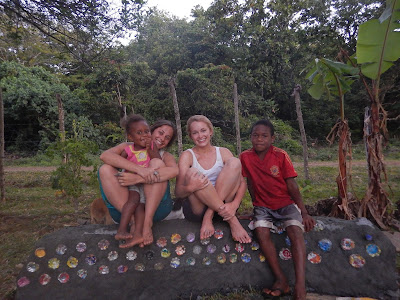
 My friend Samantha visited and I figured that this would be an easy breezy project for us to tackle. Like almost every project I find myself tangled up in, I underestimated the work that would go into it. Sometimes I just picture things completing themselves. Mix the cement, pour it into the hole, sprinkle fairy dust, and poof! A market house! This, I have found out the slow and unfortunate way, is not so. And in the case of the bottle brick bench, the same goes. It was hard, but it was fun. One of my favorite memories of construction day was Sam singing “Vacation, all I ever wanted” and us almost peeing our pants at the truth in that. But at the end of the day we got to sit on the finished product and feel good. What didn’t feel good, however, were our fingers for the next few days. Take note: cement kakaes your skin and makes your hands covered in holes, burning, and very useless. But you just built something, so it’s time to relax anyway! 

It’s a simple little bench tucked away underneath a mandarin tree by the road. It serves its purpose as supporter of resting asses and subject of “look what the tuturani built” conversations. If results were measured by tangibility, it wouldn’t do much justice. The best things that have come out of the bottle brick project have little to do with the bench.

One noticeable change I’ve seen is how much less trash there is surrounding the school grounds. The kids picked ol ples blo doti clean! This visual difference is something – the place no longer looks like a scattered dump and the teachers and students are more conscious of what they’re saking. And I am, too. Until I scattered my own collected trash out on the classroom floor for us to pack into empties, I hadn’t realized how much waste I create and throw away. This project forced me to ask myself, “Where is away?” And I’m happier knowing that this waste has found a new home – cradle to cradle – instead of just being thrown out back or burned at the stake – cradle to grave. And to top it all off (ha!) I’ve really loved the impromptu trash talks people ask me to give. What to burn, what not to burn, what to do with batteries. My favorites are the nakamal speeches on BPA requested by this apu or that uncle whenever I show up at a kava bar with my papa. If these instances spark interest in anyone, even if it’s just a kava drunk thought trail, than that’s fantastic. That’s what it’s all about. Making us more mindful about our everyday practices and the impact of our actions. Hemia nao!

Furthermore, bottle bricking is wonderful if classroom teaching isn’t your favorite thing. I’ve gotten to talk about cleaning up the environment, actually clean up the environment, and organize trash dances, all outside of the confines of the classroom. You can get creative and throw in plenty of English literacy if that interests you, too. Use the bottles as paper and have spelling tests on them. Discuss with the older students our roles as protectors of the land and have them write a paragraph or essay about it. Write vocabulary words on the bottles and hide them like easter eggs, whoever finds and defines the most wins. Set the bottles up as pins and go bowling! If you knock down 5, you have to come up with a 5-letter word about whatever this week’s theme is. Or make a sentence with five words. Or pretend you’re a puskat for 5 meows. Whatever works! 

In fact, my favorite teaching days are what I call “free for all” when the class goes outside and collects trash. You’ll be amazed to see how exhilarating this is for the students. They all do the quiet “yes yesss” hissing and run out the door like I’ve told them they get to do probably anything other than pick up trash. I’ve even found a few gems while on these outings – a sturdy bowl that just needed a dent popped out of it and a couple of knives that could use a good sharpening. As they say, one man’s trash is another man’s treasure! And speaking of that, this project inspired some more trash to treasure projects as well. Like transforming beer bottles into hanging vases and recycling tin cans into funky wind chimes. We painted the oldfala water tank at my school and now look at an underwater mural instead of a grey cement cylinder. The students in the Niko Si aka Yu Yes aka good behavior club got to paint their sea creatures at the end of the school year, which made them super cool for being good kids. It was so fun watching their creativity flow on this huge canvas. The beautiful tank art is a reminder of the power of positive reinforcement and the joys that come with collective arts and crafts!  

So, where to start? Visit ecobricks.org and download their vision and construction PDF guides. Make a model bottle brick. Or 8. Present the idea at a staff meeting and teach them how to build them first. When I introduced it to the classes, I had a whole spiel I went through. On the board we listed out aelan kakae. I would use corn as the example and talked about the husk and how it protects the food inside. I asked the students what you do with the covering once you’re ready to eat the corn – sak it. Ok, afta? The husk rots and returns to the earth (learning the local word for ground or land helped me with this). Next we listed out kakae blong stoa. I asked what you do with the noodles wrapper once you’re ready to eat the noodles – sak it. Ok, afta? Stumped! Because, as we know, the plastic doesn’t rot and return to the earth, but I think that can be hard to conceptualize when littering is accepted and normal here. So we’d talk this out and discuss why it’s bad. And also why burning plastic is bad (get into whatever science they’re itching for!) and if burning and saking are out of the question, what do we do? We bottle brick! 

Explain the steps, the rules, the purpose, etc. and there you go. Shoot any questions you have my way and once I’m gone in March, take advantage of Caroline and Cole’s toolbox. Their bottle brick project is a huge success and I know they’ve come up with some creative elements that work for their community. 

And from one dirty girl to another, happy bricking!


yahoo!